

How to Choose a Vintage Sapphire Ring: Kashmir, Burma, and Ceylon Explained
Aug 11, 2024
by Suzanne Sachs • 5 min read

Vintage sapphire rings offer something you won’t find in a modern jewelry store. Whether you’re searching for an engagement ring, a cocktail ring, or a piece you’ll wear for decades, a vintage sapphire carries a depth of color, handcrafted detail, and a sense of history that no new ring can replicate. Knowing how to choose the right one makes all the difference.

In This Article:
- What Makes a Sapphire Ring Vintage?
- Sapphire Colors: What to Know Before You Buy
- Victorian, Edwardian, and Art Deco Sapphire Rings
- How to Choose the Right Setting Style
- Kashmir, Burma, and Ceylon: Why Origin Matters
- Frequently Asked Questions
Vintage Sapphire Ring Styles
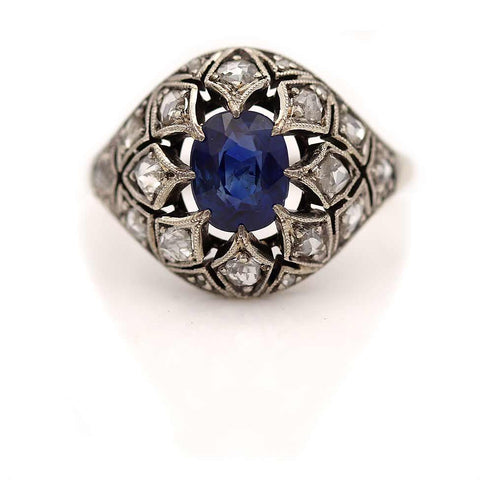
Sapphires appear throughout nearly every major jewelry era, each used in distinctly different ways. Victorian rings often feature sapphires as bold center stones, surrounded by rose cut diamond halos and set in yellow or rose gold with intricate floral detail. Edwardian designs favor platinum and white gold, pairing sapphires with delicate filigree and milgrain for a lighter, more refined look. Art Deco settings introduce geometry and contrast — sapphires set alongside baguette diamonds, emerald cuts, and calibré-cut stones in bold, architectural arrangements that remain instantly recognizable today.
What surprises many buyers is how differently a sapphire reads across these eras. The same deep blue stone can feel romantic in a Victorian setting, refined in an Edwardian design, and bold in Art Deco platinum. Understanding which era speaks to you is often the first step in finding the right ring.
Choosing Your Perfect Sapphire Ring
Finding the right vintage sapphire ring comes down to three things: the era that speaks to you, the type of sapphire you love, and your budget. Every other decision flows from there. Era shapes everything — the metal, the setting style, the overall feeling of the ring on your hand. Sapphire type determines color, origin, and rarity. A deep blue Kashmir sapphire and a soft pink Ceylon stone are both extraordinary but they are entirely different choices. And budget matters not because vintage sapphires are unaffordable — they are often exceptional value compared to modern stones — but because knowing your range helps focus the search on what is truly possible rather than what is out of reach.
Getting clear on these three things before you start looking will save time and make the decision far easier when the right ring appears.
Sapphire Color and Origin: What to Know Before You Buy
Sapphires are best known for their deep blue hues, but the color range is far broader than most buyers realize — from vivid royal blue to soft pink, golden yellow, violet, and colorless white. Understanding both color and origin is essential, as where a sapphire comes from is closely tied to its character and value. Kashmir sapphires are among the rarest and most prized, known for their velvety blue tone and soft inner glow. Burmese sapphires are celebrated for their rich, vivid color, while Ceylon stones from Sri Lanka are prized for their lighter, brighter blue and exceptional clarity. Madagascar has emerged as a respected modern source, offering sapphires with strong, saturated color across a range of hues.

Which Era Is Right for You?
If the styles section gave you a sense of each era's personality, this goes one step further — because the era you choose affects not just how the ring looks but what to expect when you buy it.
Victorian sapphire rings, made between 1837 and 1901, are the oldest pieces in this collection. They tend to feature rose cut diamonds alongside sapphires, set in yellow or rose gold with elaborate engraving and symbolic detail. Because of their age they require careful inspection, but a well preserved Victorian ring is among the most romantic and distinctive pieces in vintage jewelry.
Edwardian rings from 1901 to 1915 are defined by platinum and white gold, fine filigree, and a delicacy of construction that reflects the era's taste for elegance over boldness. Sapphires in Edwardian settings tend to be refined rather than dramatic — a perfect choice for someone who wants understated sophistication.
Art Deco rings from the 1920s and 1930s are the most architectural of all vintage eras. Sapphires appear as bold geometric accents — calibré-cut stones fitted precisely into platinum settings alongside Old European cut diamonds. These rings make a statement.
Mid-Century rings from the 1940s and 1950s sit between vintage and modern. Settings are cleaner and less ornate than earlier eras, but the sapphires themselves are often exceptional quality — and because Mid-Century pieces are less well known than Victorian or Art Deco, they frequently represent outstanding value.

Setting Style: Finding the Right Look
The setting is what brings a sapphire to life — and the right choice depends entirely on how you plan to wear the ring and what draws your eye. A solitaire setting lets the sapphire speak for itself. With nothing to compete for attention, the color and character of the stone become everything. This works beautifully for exceptional sapphires — a deep Kashmir blue or a vivid Burma stone that needs no embellishment.
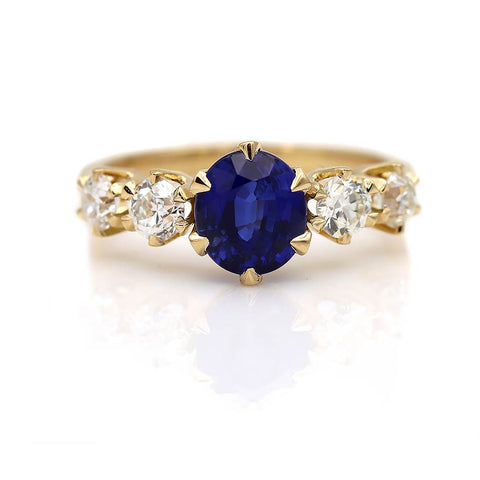
A halo setting surrounds the sapphire with diamonds, adding brilliance and making the center stone appear larger. In vintage pieces, halos are often hand-set with Old European cut diamonds or rose cuts, giving them a warmth and detail that modern halo settings simply cannot replicate. A three stone setting pairs the sapphire with two flanking stones — diamonds, or sometimes a complementary gemstone. In vintage rings this arrangement carries symbolic meaning, representing the past, present, and future of a relationship. For cocktail rings and evening pieces, more elaborate settings with multiple sapphires or bold geometric arrangements reflect the maximalist spirit of Art Deco and Mid-Century design.
Ultimately the setting that is right for you is the one you cannot stop looking at. That has been true for every customer who has ever found their ring — the right piece makes the decision for you.
Creating Your Own Vintage Sapphire Ring
If you cannot find exactly the right piece, there is another option worth considering. A loose sapphire can be reset into an authentic vintage diamond ring — preserving the history and craftsmanship of the original setting while adding the color and character of a stone you love. The result is something entirely personal and entirely one of a kind. This works equally well in reverse. If you already own a vintage sapphire — perhaps inherited or collected over the years — setting it into a vintage ring rather than a modern mounting keeps the integrity of both pieces intact. Two layers of history in a single ring.
Frequently Asked Questions
What is the most valuable sapphire color?
The most prized sapphires come from Kashmir, Burma, and Ceylon. Kashmir sapphires are the rarest, known for their deep velvety blue with a soft inner glow. Burmese sapphires offer an intense vivid blue, while Ceylon sapphires are celebrated for their brilliant lighter blue and exceptional clarity.
What makes a sapphire ring truly vintage?
A truly vintage sapphire ring was made between the late 19th and mid-20th century — spanning the Victorian, Edwardian, Art Deco, and Mid-Century eras. Each period has its own distinct character and craftsmanship, and no two authentic vintage sapphire rings are exactly alike.
Are vintage sapphire rings good for everyday wear?
Sapphires are an excellent choice for everyday wear. With a hardness of 9 on the Mohs scale — second only to diamonds — they are exceptionally durable. With proper care a vintage sapphire ring will remain as beautiful decades from now as it is today.
Finding the Vintage Sapphire Ring That Is Right for You
The right vintage sapphire ring is not found by checking boxes. It is found when a piece stops you — when the color, the setting, the era, and the feeling of it on your hand come together in a way that makes every other option irrelevant. That moment is different for every person. Some find it immediately. Others take time. After 35 years of helping customers find these extraordinary pieces, the one thing that has never changed is this — the right ring always makes the decision for you.
When you are ready to find yours, browse our collection of vintage sapphire rings — each one carefully sourced, authenticated, and entirely one of a kind.
Suzanne Sachs

